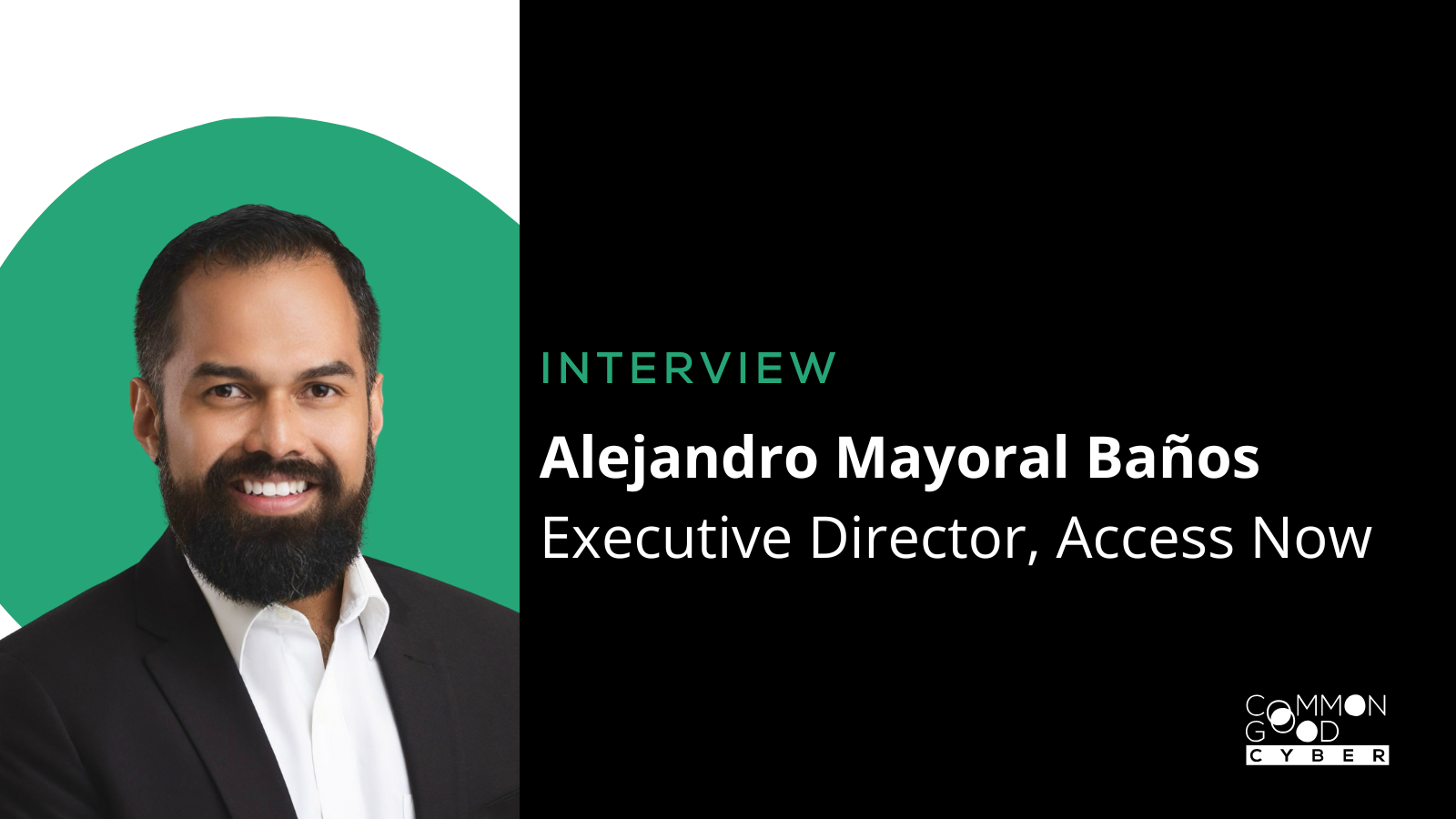
We interviewed Alejandro Mayoral Baños, Executive Director of Access Now, to learn more about its mission, how its Digital Security Helpline supports and protects communities at risk, and how efforts like Common Good Cyber can solve some of the persistent barriers civil society organizations face.
Can you introduce Access Now and its role in defending digital rights around the world? How does this overlap with cybersecurity efforts globally?
Access Now defends and extends the digital rights of people and communities at risk. As a grassroots-to-global organization, we partner with local human rights defenders and movements to bring a human rights agenda to the use, development, and governance of digital technologies, and to intervene where technologies threaten our human rights. By combining direct technical support, strategic advocacy, grassroots grantmaking, and convenings such as RightsCon, we fight for human rights in the digital age.
The Digital Security Helpline is a key initiative of Access Now. Can you share a success story where the Helpline helped protect individuals or organizations from cyber threats?
Access Now’s 24/7 Digital Security Helpline works to not only support and protect targeted members of our community but also to hold perpetrators to account. Last year, Access Now’s report, Spear-Phishing Cases from Eastern Europe in 2022-2024: A Technical Brief, exposed two spear-phishing campaigns — highly personalized, targeted attacks — mounted against people in Russian and Belarusian nonprofit organizations, independent media, international NGOs, and at least one former U.S. ambassador. The investigation and accompanying digital security recommendations were conducted and developed in collaboration with the Citizen Lab, First Department, Arjuna Team, and RESIDENT .ngo. Not only did these revelations shine an international spotlight on this dangerous and opaque world through significant press coverage, the report encouraged other victims to contact Access Now’s Digital Security Helpline for further support, and contributed to the investigations and enforcement actions mounted by the U.S. Department of Justice (DOJ) and Microsoft, as well as the termination of a number of malicious IP (Internet Protocol) addresses and web domains by other service providers.
Funding and sustainability are major challenges for nonprofit digital rights organizations. What resources are essential for Access Now to continue its mission?
The significant downturn in funding and sustainability has meant that Access Now, and the entire digital rights community, are forced to reallocate resources and redefine the impact of our programs. The funding landscape has simply become untenable for long-term planning, and, like many organizations caught in this financial decline, we are pivoting to prioritize immediate needs. As a grassroots-to-global organization deeply embedded in the digital rights ecosystem, this shift in funding has compelled us to confront the multifaceted harm being inflicted on our community.
Access Now’s continued impact fundamentally relies on four critical resources:
- Sustaining our 24/7 Digital Security Helpline: This service provides immediate, direct assistance to activists, journalists, and civil society actors facing digital threats globally. In a time when digital attacks are rising, maintaining this lifeline is not only essential, but also urgent.
- Grantmaking to grassroots organizations: Financial support for grassroots partners, especially in regions severely impacted by shrinking civic spaces and resources, remains a cornerstone of Access Now’s approach. This pass-through funding allows local organizations to respond directly and effectively to threats.
- Convening multistakeholder spaces: RightsCon has become an indispensable community where civil society, governments, and Big Tech can engage in dialogue, collaborate, and hold powerful actors accountable. Continued support ensures the digital rights community remains united, influential, and capable of impactful advocacy. Also, our advocacy work at different international spaces, such as the Internet Governance Forum (IGF), United Nations (UN), and Freedom Online Coalition will continue to be crucial to continue moving the agenda of digital rights.
- Advocacy for digital resilience and platform accountability: Advocating for robust protections, responsible governance of tech platforms, and transparency in digital practices is ever-more critical. This advocacy addresses the evolving digital threats communities face, from surveillance to misinformation to censorship.
These areas require robust financial backing and collaboration. Supporters can support our work by connecting Access Now with other actors, networks, and Human Right defenders who align with our vision and strengthen the broader ecosystem — it’s our networks and collaborations that are at the core of our impact.
What are the biggest priorities for Access Now in the coming years, and what support would help you achieve them?
Access Now’s biggest priority moving forward is to remain community-focused. The reason our grassroots-to-global model works is because we listen and learn from local partners and team members in all regions. We center those most directly impacted by digital rights violations, fighting alongside individuals and communities to uphold and defend their rights. We meaningfully consult with and learn from others, amplifying local partners’ expertise and experiences at key international fora and vice versa.
Looking ahead, Access Now is prioritizing two strategic pillars in our work: digital resilience and platform accountability.
- Digital resilience involves equipping communities, individuals, and organizations to withstand digital threats, such as surveillance, Internet shutdowns, and cyberattacks. We aim to build and sustain secure digital infrastructure and practices globally.
- Platform accountability is increasingly vital as technology companies shape daily life and governance. We prioritize holding these platforms to standards of transparency, responsibility, and human rights compliance, directly addressing the emerging authoritarian alliances and business practices that marginalize user rights and democratic principles.
Additionally, we see a pressing priority in advocating for governments and private foundations to collaboratively address the resource gaps within the digital rights ecosystem. Current geopolitical trends and budget contractions have exacerbated threats to digital rights, increasing the urgency of maintaining diverse, sustainable funding and resource networks.
How can efforts like Common Good Cyber best contribute to Access Now’s mission?
Recognizing and acting on the deep structural challenges that cybersecurity organizations like ours face — primarily in long-term sustainability — is the best way for efforts like Common Good Cyber can contribute to Access Now’s mission. It has become the norm in civil society to always pull ourselves up by the bootstrap. Although it’s commendable, it largely ignores the structural barrier that civil society faces in being long-term financially resilient, which would not only help ensure we achieve the organization’s mission, but would mean that real change is happening on the ground.